1 of 45
This Bronze Age armor was found near the city of Omsk in Siberia in 2014. It likely belonged to an “elite” warrior of the time period. Archaeologists suspect that the armor, buried between 3,500 and 3,900 years ago, was made of elk, deer, and horse bones.Siberian Times
2 of 45
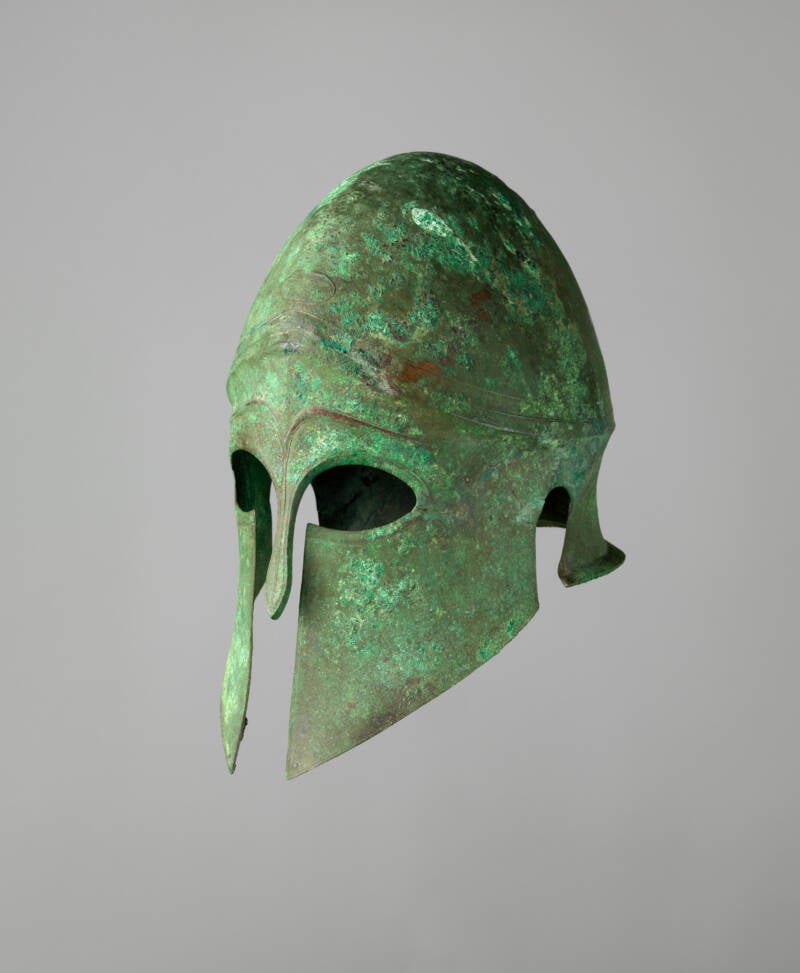
This helmet, found in 2007 in the Mediterranean Sea, likely belonged to a Greek soldier who fought in the Persian Wars in the 5th century B.C.E. Archaeologists suspect that the soldier lost his helmet 2,600 years ago when he dropped it in the water, or when his ship sank.Clara Amit/Courtesy of the Israel Antiquities Authority
3 of 45
Armor that belonged to Philip II of Macedon, the father of Alexander the Great. This cuirass dates back to the 4th century B.C.E. Hellenic Armors
4 of 45
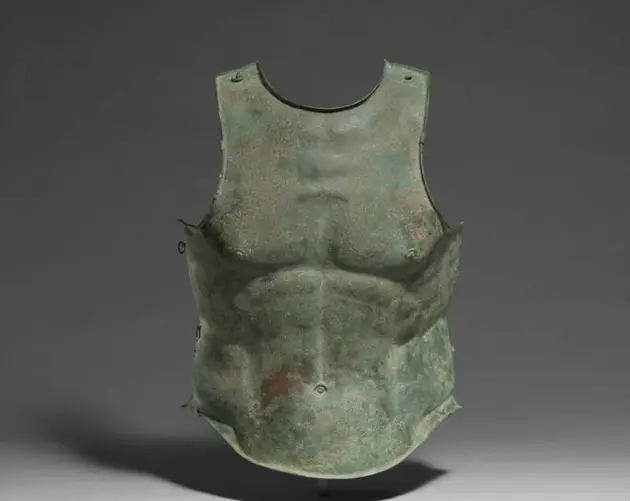
A bronze Greek cuirass from the 4th century B.C.E. According to the Metropolitan Museum of Art, this piece made up a crucial part of a warrior’s body armor.Metropolitan Museum of Art
5 of 45
Archaeologists found this “bionic” armor, made of 5,000 leather scales, in an ancient Chinese grave in 2022. It’s believed to be 2,500 years old. Patrick Wertmann
6 of 45
A helmet worn by an ancient Greek warrior 2,500 years ago, likely during the Battle of Alalia. This incredible artifact was uncovered in southern Italy in 2022.Parco Archeologico Paestum
7 of 45
A rare lorica segmentata, armor worn by ancient Roman legionaries. This set of armor was found in 1964 in modern-day England, and likely dates to the 1st or 2nd century C.E.Archaeo-Histories/Twitter
8 of 45
This 1,800-year-old iron face mask was likely worn by a member of the Roman cavalry. It was discovered in the ancient city of Hadrianopolis in modern-day Turkey, which archaeologists have been excavating since 2003. Ahmet Ozler/Anadolu Agency/Getty Images
9 of 45
This suit of armor is made of a curious material — crocodile skin. Worn by a Roman in the 3rd century C.E., it reflects Roman interest in Egyptian culture. British Museum
10 of 45
These items were found buried with a 6th-century warrior in present-day Gammertingen, Germany. He had a Byzantine helmet, mail armor, and weapons.History Museum Württemberg
11 of 45
A strap helmet, or “Spangenhelm,” found in the Saône River near Trévoux, France. This helmet dates from the 6th or 7th century, and may have been a diplomatic gift to a foreign ruler from the Byzantine court or from the Ostrogothic kingdom. Metropolitan Museum of Art
12 of 45
The Sutton Hoo helmet, discovered among other grave goods in modern-day England in 1939. The 7th-century headgear possibly belonged to Raedwald, the ruler of the kingdom of East Anglia.British Museum
13 of 45
The so-called Gjermundbu helmet is considered the best preserved Viking helmet in the world. Interestingly enough, it was discovered completely by accident in 1943 on a farm in Norway. It dates to around 970 C.E.Wolfmann/Wikimedia Commons
14 of 45
Near the Gjermundbu helmet, archaeologists also recovered this set of chain mail. Though it was found in pieces, the original set may have weighed up to 22 pounds, and could have taken six months to create.Wolfmann/Wikimedia Commons
15 of 45
Chain mail armor that still holds a skull inside, recovered from the site of the Battle of Visby. This 1361 clash between Swedish farmers and Danish troops resulted in the deaths of 1,800 Swedes. However, this particular skull likely belonged to a Danish soldier.The Swedish History Museum
16 of 45
This 15th-century helmet is alleged to have belonged to Joan of Arc, the legendary patron saint of France. According to the Metropolitan Museum of Art, the helmet’s true provenance is unknown, but it does appear to have been damaged in battle.Metropolitan Museum of Art
17 of 45
A 15th-century cuirass from Japan. Made of various materials like iron, leather, and silk, this piece of armor would have been worn by a samurai or his retainers.Metropolitan Museum of Art
18 of 45
This armor from the 15th or 16th century likely belonged to an Iranian or Turkish warrior. A shirt of mail and plate, it was probably used both for battles and ceremonial purposes.Metropolitan Museum of Art
19 of 45
Elephant armor from Northern India during the Mughal Empire. It dates back to the 16th century, and in its complete form, it weighed as much as 350 pounds.Geni/Wikimedia Commons
20 of 45
A 16th-century piece of armor from Poland that’s made of steel rings and 1,074 steel plates.Krakow Royal Armories
21 of 45
This 16th-century armor would have been worn by a cavalry soldier in Italy. Made circa 1510, the armor includes Christian imagery and inscriptions in Latin.Metropolitan Museum of Art
22 of 45
Golden armor that likely belonged to King Henry VIII of England. This set was probably made around 1527, about 20 years into the king’s reign. Metropolitan Museum of Art
23 of 45
Steel armor belonging to King Henry VIII. Unlike the previous set of armor, this armor dates to 1544, near the end of the king’s life, when he was overweight and struggling with gout.Metropolitan Museum of Art
24 of 45
A breastplate worn by Holy Roman Emperor Ferdinand I. This armor was made circa 1549, and was appropriately intricate for the designated successor to his brother, Emperor Charles V.Metropolitan Museum of Art
25 of 45
An Italian helmet shaped like a griffin, dating back to 1550. According to the Metropolitan Museum of Art, its elaborate design suggests that it was pageant armor.Metropolitan Museum of Art
27 of 45
Armor belonging to Emperor Maximilian II of Austria. This intricate suit of armor was made around 1555.Thesupermat/Wikimedia Commons
28 of 45
Italian armor for a warrior and his horse, which belonged to a member of the noble Collalto family. The horse’s armor dates to circa 1560, and the man’s dates back to circa 1575.Metropolitan Museum of Art
29 of 45
An elaborate wolf’s head helmet from circa 1560. This stunning piece of armor belonged to Archduke Ferdinand II of Austria.Kunsthistorisches Museum
30 of 45
This intricate French ceremonial armor dates back to circa 1575-1580. Though it was damaged in a fire, its inscribed depictions of battle are still visible.Metropolitan Museum of Art
31 of 45
A helmet and armor from the Maratha Empire in India. Circa early 18th century.Pebble101/Wikimedia Commons
32 of 45
Royal armor that was likely presented to five-year-old Luis, Prince of Asturias, by his grandfather. Circa 1712.Metropolitan Museum of Art
33 of 45
A suit of armor belonging to Sultan Mustafa III of the Ottoman Empire. Displayed at the Topkapi Palace Museum in Istanbul, Turkey, the armor boasts 40,000 steel and gold links and dates back to the 1700s.moozambiqq/Reddit
34 of 45
Japanese facial armor from circa 1745. According to the Metropolitan Museum of Art, it depicts Jikokuten, the guardian of the East and one of the Four Kings of Heaven. Metropolitan Museum of Art
35 of 45
A Japanese samurai helmet. This helmet, which includes an octopus design, dates back to the 18th century.Stibbert Museum
36 of 45
The armored skeleton of Saint Pancratius, a Christian martyr from modern-day Turkey. He was brutally killed for his faith around 304 C.E., when he was just 14 years old. His armor was added in the 18th century.Dbu/Wikimedia Commons
37 of 45
Japanese armor from the 18th century known as Gusoku.Metropolitan Museum of Art
38 of 45
Korean armor from the 18th century. Unlike most of the other armor on this list, this Korean armor is made from fabric — specifically from several layers of fabric, which were meant to deflect a blow or even a blade.Metropolitan Museum of Art
39 of 45
Ceremonial Chinese armor from the 18th century, inscribed with sacred Buddhist mantras.Metropolitan Museum of Art
40 of 45
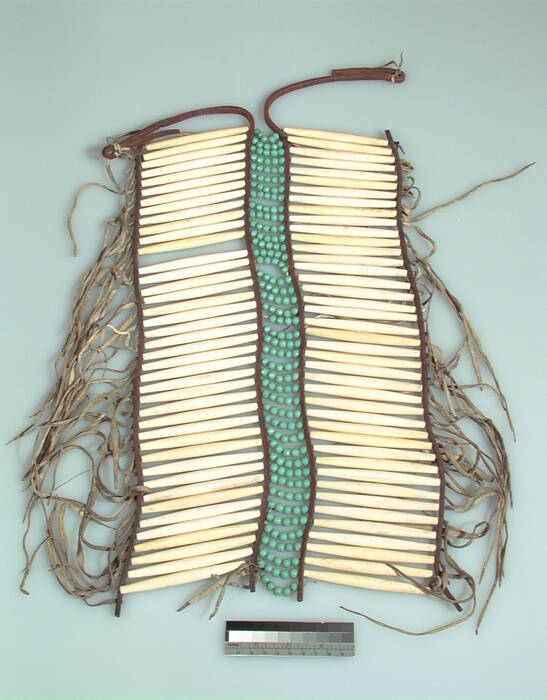
An Oglala Native American breastplate made of bone. Circa 1860s.Daderot/Wikimedia Commons
41 of 45
Covered from head to toe in iron nails, this armor is often described as a Siberian bear-hunting suit from the 1800s — but its true origins remain mysterious.Twitter
42 of 45
Nineteenth-century armor from the Gilbert Islands. It’s made from coconut fiber and blowfish skin. Daderot/Wikimedia Commons
43 of 45
This breastplate was worn by a French soldier who was struck and killed by a cannonball during the Battle of Waterloo on June 18, 1815. He was one of the 40,000 casualties that the French suffered during the fight. Musée de l’Armée
44 of 45
One of Japan’s last samurai wearing his armor alongside his retainers in Yokohama. Circa 1870s.Felice Beato/The New York Public Library
45 of 45
Like this gallery?
Share it: